
 Earrings
 Chandbalis
 Jhumkas
 Earcuffs
 Oxidized Earrings
 Tassel (Long Earrings)
 Handmade Fabric Earrings
 Kundan
 Necklace
 Royal Heritage Necklaces
 Handmade Necklace
 Saree
Saree Assamese Saree
 Personalized Gifts & Decor
 3D Miniature Frames
 Resin Art Gifts
 Photo Frames
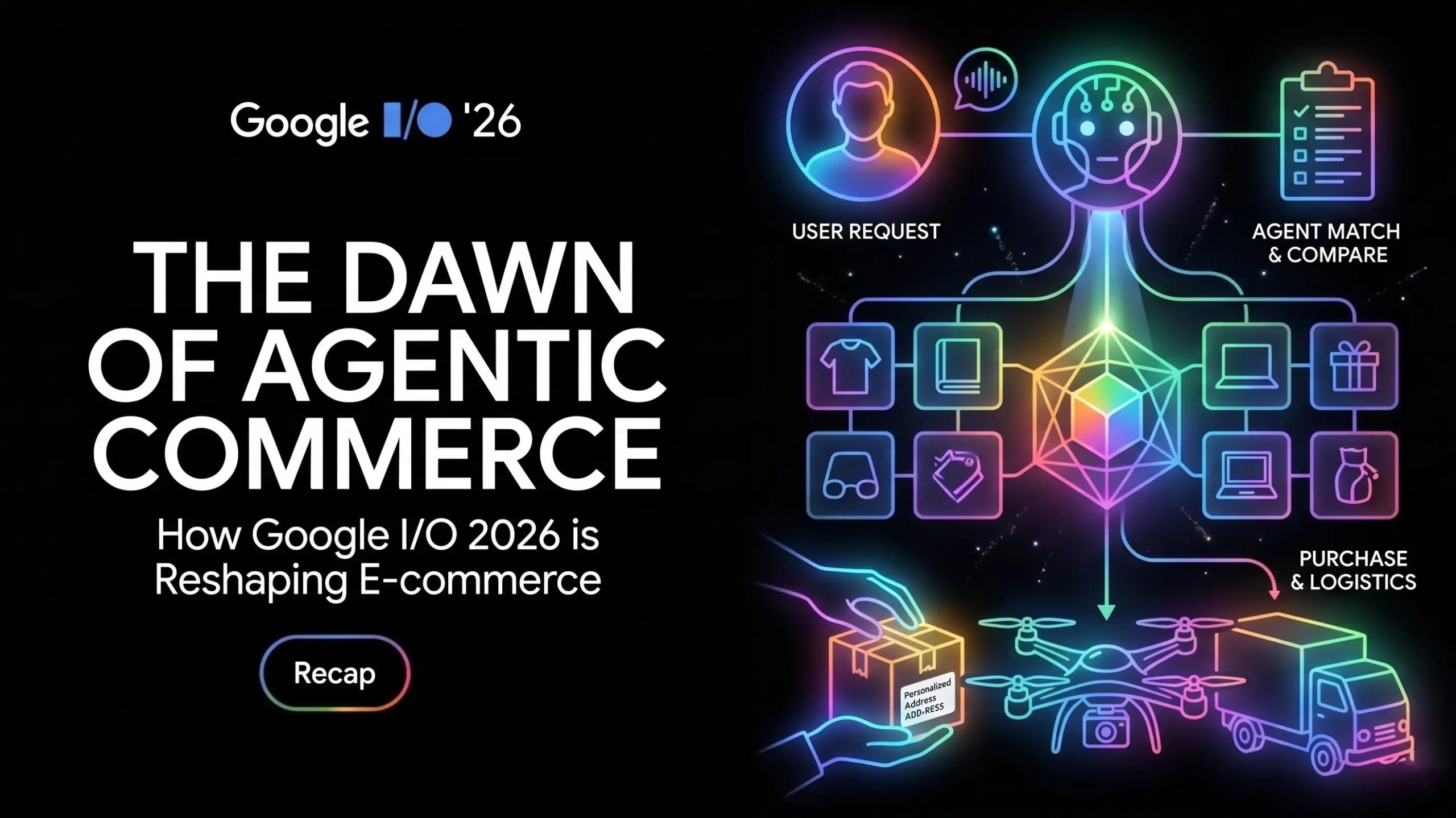
The digital commerce environment is undergoing a huge, unprecedented paradigm shift right now. The landmark Google I/O 2026 event heralded the definitive transition: the age of passive product discovery is over. We are now in the age of active, autonomous execution, dubbed “agentic commerce.” Search engines are no longer digital directories of sorts, where shoppers click links to peruse online storefronts. Instead they have become living self-sufficient environments. Here, sophisticated multimodal models such as Gemini 3.5 Flash and Gemini Omni are powering personal AI agents that handle product research, complex price comparisons, and even executing secure transactions seamlessly in the background.
The traditional e-commerce purchase funnel is being radically consolidated by the introduction of breakthrough infrastructure like the cross-platform Universal Cart, the machine-to-machine Universal Commerce Protocol (UCP), and strict financial guardrails through the Agent Payments Protocol 2 (AP2). This is a fundamental shift in how brands and retailers manage customer acquisition, digital visibility and transactional flows. Success in this new era will hinge not on traditional SEO or basic aesthetic web design, but on how seamlessly a brand's backend systems and data feeds can integrate with these autonomous AI networks. This definitive guide looks at what Google’s agentic shopping revolution means for your business, covering all the new tools, protocols and updates that are redefining the buyer journey.
E-commerce Impact Summary: Agentic Commerce |
|---|
|
Gemini 3.5 & Omni: The Architecture of an Agentic Future
Gemini 3.5 Model Series
Google announced the Gemini 3.5 family, designed specifically for “frontier intelligence with action” and agentic coding workflows. The flagship of this rollout is Gemini 3.5 Flash, which has officially replaced earlier models to become the global default in Google Search’s AI Mode and the Gemini app. It's much better than its predecessor, Gemini 3.1 Pro, on all major coding benchmarks, scoring 76.2% on Terminal-Bench 2.1, 1656 Elo on GDPval-AA, 83.6% on MCP Atlas and 84.2% on CharXiv for multimodal understanding.
Its most distinctive quality is its speed, generating tokens four times faster than similar models. Plug it into Google’s Antigravity 2.0 coding environment and it runs a stunning 12 times faster. That’s less than half the cost of other leading models – a potential saving of over $1 billion per year for top enterprise customers if they were to migrate 80% of their workloads. It is designed for long horizon tasks and can autonomously plan, write code, self-correct and perform complex workflows. Next up is Gemini 3.5 Pro, now testing for the most demanding enterprise jobs, scheduled for launch in June 2026.
Gemini Omni: The Multimodal “World Model”
Gemini Omni: Google is “simulating reality” beyond text prediction This native multimodal model takes text, audio, image and video inputs together. It is a leap forward in our understanding of intuitive physics, kinetic energy and gravity, turning complicated concepts into very precise video simulations. It also allows conversational video editing, where users can upload raw footage and use natural language to change environments (e.g., switching from day to night), modify camera angles to 360 degrees, or add elements while maintaining frame consistency. It even has a digital avatar generation feature. The first version, Gemini Omni Flash, is available to AI Plus, Pro, and Ultra subscribers, as well as via YouTube Shorts and the Creator App.
Nano Banana (Gemini 2.5 Flash Image Model)
The breakout star, Nano Banana, has generated over 50 billion images and powers advanced e-commerce features such as Virtual Try-On and Digital Twins. Consumers can upload a selfie to create a studio-quality, full-body digital twin of themselves and virtually try on clothes from billions of listings in the Google Shopping Graph. It also powers mobile editing on the go in Chrome for Android and opens the door for Google Pics, a new Workspace app for detailed image editing inside Docs, Slides and Drive.
E-commerce Analysis: Gemini & Multimodal AI |
|---|
|
Edge Computing, Hardware & Infrastructure
AI and Edge Computing Built-in
Google is aggressively pushing compute to local devices to cut down latency. Chrome 148 ships with stable Prompt API running natively on Gemini Nano. Also included is Gemma 197M, an ultra-efficient expert model that can run locally in Chrome and power task-specific APIs seamlessly without server constraints. The LiteRT-LM backend for mobile can achieve prefill speeds over 3,000 tokens/sec for on-device GenAI. Plus, on-device models now support the open-source Model Context Protocol (MCP) so that phones can be local decision-making agents without having to rely on the cloud.
Hardware & Compute: TPU v8 Architecture
Google announces massive annual infrastructure investment of $180 to $190 billion and Tensor Processing Units (TPU v8) to support quadrillions of processed tokens. This is the first time Google split the architecture into two chips: TPU 8t (Training) provides 3x raw compute power, scaling to 9,600 chips per super pod with 121 exaflops of compute. Training now scales globally over 1 million TPUs using JAX and Pathways, delivering 97% “goodput”. TPU 8i (Inference) Built solely for speed, outputting nearly 1,500 tokens per second with a new “board-fly” architecture. Both chips provide two times the performance per watt.
E-commerce Analysis: Edge AI & Hardware |
|---|
|
The Rise of Agentic Commerce & Shopping AI
Gemini Spark & Search Information Agent
The flagship announcement is Gemini Spark, a 24/7 cloud-based personal AI agent that runs in the background constantly. Spark integrates deeply with Google Workspace and connects with over 30 third-party apps via MCP (Uber, Zillow, Instacart, etc.) It proactively manages multi-step chores, like checking your credit cards or preparing an Instacart grocery order based on your calendar. And Search Information Agents that scour the web 24/7 for very specific criteria (eg. apartment listings with the right light, or specific sneaker drops), providing synthesized updates. Agents are also getting real-world things done, with the ability to autonomously book digitally, and even make physical phone calls for local services without digital scheduling.
Universal Cart: The Intelligent Shopping Centre
The Universal Cart is a cross-platform hub powered by Gemini that collects products across Search, the Gemini app, YouTube and Gmail. It actively tracks deals, checks the price history, and notifies you when the item is in stock. It uses intelligent reasoning to flag incompatible product (e.g. mismatched PC parts), and uses Google Wallet to automatically apply loyalty points and hidden savings. Shoppers can check out seamlessly with Google Pay. Initial partners include Walmart, Target and thousands of Shopify merchants, ensuring the retailer remains the merchant of record.
Universal Commerce Protocol (UCP) & Agent Payments Protocol 2 (AP2)
UCP is the “HTTP of Agentic Commerce” — a standardized open source protocol for AI agents and retail systems to communicate on research, pricing, checkout and tracking. It’s backed by Shopify, Amazon, Walmart and Stripe, going global, and natively supports Buy-Now-Pay-Later (BNPL) options like Klarna. AP2 is the financial guardrail to get us there.” It lets users set hard spending limits and brand authorizations with cryptographic, tamper-proof digital mandates, so that returns and refunds are safe.
E-commerce Analysis: Agents, Cart, & Protocols |
|---|
|
Google Marketing 2026: Enter the “Agent Architect”
Search Ads & Direct Offers Powered by AI
Google is transforming media buyers into “Agent Architects” who feed first-party data into AI systems that handle campaign execution autonomously. New ad formats for conversational shopping. AI-Powered Shopping Ads generate custom explainers for high-consideration items within the ad. Conversational Discovery Ads generate transparent AI explainers on the fly to match complex queries. Direct Offers group coupons based on real-time conversational context and include native checkout integrations so users can purchase on the spot without leaving the AI Mode interface. The new Business Agent for Leads replaces static forms with an interactive chat that qualifies in real time and is trained on the advertiser’s site.
Demand Measurement & Gen
Measurement becomes predictive AI. Google has also rolled out Qualified Future Conversions (QFCs), a Gemini-powered metric that links short-term actions to long-term revenue. Meridian, an open source marketing mix model, is now in Analytics 360. Demand Gen campaigns have grown to allow advertisers to directly grow affiliate creator partnerships, serve ads natively on Google Maps and scale hyper-personalized product videos.
Merchant Centre Data Specifications
“Your data must be clean for an AI agent to buy your product.” Google has launched Ask Advisor, the one collaborator that combines Ads, Analytics and Merchant Centre for easy reporting and cross-platform intelligence. Conversational attributes are required for the new Merchant Centre specifications, as well as the new shipping/loyalty attributes (handling_cutoff_time, loyalty_program_label), and a [video_link] attribute. Importantly, from 2027 a hard minimum image resolution of 500x500 pixels will apply to all categories.
But if your e-commerce business is based on solid WordPress installations, perhaps using WooCommerce combined with complex themes like WoodMart, then you must realize that these new data feeds require clean, native code integration. You can’t just edit core WoodMart structures with Elementor to meet these deep backend API requirements. Rather, you must make sure your catalogue plugins and core theme settings output the clean, machine-readable data Google’s systems need directly.
Media Provenance Infrastructure for Trust and Safety
Google has expanded its invisible watermarking, SynthID, across 100 billion images and videos to combat deepfakes. Detection tools are now built into Chrome and Search natively, adopted industry-wide by OpenAI, ElevenLabs, and NVIDIA. C2PA Content Credentials allow users to verify if media was captured or generated, built into Pixel cameras and supported by Meta for Instagram. CodeMender Code API for enterprise security scanning codebases for vulnerabilities and recommending fixes and patching them autonomously. Moreover, personal agents run in fully isolated and ephemeral virtual machines (VMs) with Data Loss Prevention (DLP) policies for absolute data security.
The Revolution of Android XR and Wearables
Google has announced its “Intelligent Eyewear” based on the new Android XR platform. Launching this fall, Audio Glasses (in partnership with Warby Parker and Gentle Monster) offers heads-up help, all through audio, with Gemini, offering live translation and real-time visual context through integrated cameras. Display Glasses with in-lens visual are currently being tested. Wear OS 7 is a massive update for wearables, which will now have native support for Gemini Intelligence, customizable “Wear Widgets” and the AI-powered “Create My Widget” tool. Project Genie also enables the creation of 3D interactive worlds from real-world Street View data, acting as a virtual sandbox for training AI agents.
The Evolution of E-commerce Productivity in the Workspace 2026
Workspace is getting some big updates to conversations. Docs Live is a voice-activated writing partner, transforming verbal brain-dumps into polished drafts. Gmail Live lets you do natural voice searches to generate accurate answers from your inbox and Keep Live takes your rambling speech and converts it into structured lists. The new AI Inbox analyzes and prioritizes time-sensitive tasks, composes personalized replies and instantly surfaces related files. With Nano Banana-powered Google Pics, you can control creative elements at a granular level within a document, so you can easily resize, remove, or replace individual image objects in Drive and Slides. A native Gemini Desktop App for Mac OS provides voice dictation and local file interactivity for desktop users right on your local operating system.
Antigravity 2.0 and Developer Ecosystems
Antigravity 2.0 was a standalone agent-first desktop app that totally reimagined Google’s coding environment. It is built on Gemini 3.5 Flash, which has asynchronous task management, allowing “subagents” to work at the same time (subagents coded a full OS autonomously in 12 hours). Google is advocating for open standards with WebMCP, a proposed standard that enables websites to expose structured tools directly to browser-based agents, transforming websites into “agentic toolkits.” UI design is also undergoing a revolution with Stitch, an AI tool that converts rough prompts into code-ready interfaces, in real time. In science, models such as AlphaEarth Foundations act as a digital twin of the planet, and WeatherNext delivers hyper-accurate global weather forecasts.
Billing Evolution & YouTube Creator Studio
Google has completely changed its pricing to a “compute-used” model. Simple queries are cheap, heavy agentic tasks eat more compute. Limits now refresh every 5 hours, not cut-offs, but automatic step-downs. Google announced new AI Ultra Plans ($100/mo and $200/mo) for large-scale expansion, with up to 30TB of storage and exclusive access to Project Genie.
Ask YouTube adds conversational search to video content for creators with structured text answers and relevant clips. YouTube Shorts Remix is powered by Gemini Omni, enabling aesthetic changes via natural language, with mandatory SynthID watermarks and a likeness detection tool for protection. The Gemini app itself has been redesigned with a “Neural Expressive” interface with smooth animations, adaptive generative UI, and proactive app agents such as the Daily Brief.
Conclusion: Getting ready for the Agentic Age
The announcements at Google I/O 2026 make one thing clear: the future of e-commerce will be highly automated, deeply personalized and agent-driven. The onus is no longer on store owners to optimize for human eyes, but rather to make sure your product catalogues, merchant feeds and backend infrastructure are impeccably formatted for autonomous AI systems. “The winners in the agentic revolution will be the e-commerce brands that adopt the Universal Commerce Protocol, embrace the new advertising model of the “Agent Architect,” and leverage AI-powered productivity tools.”
