
Key Takeaways
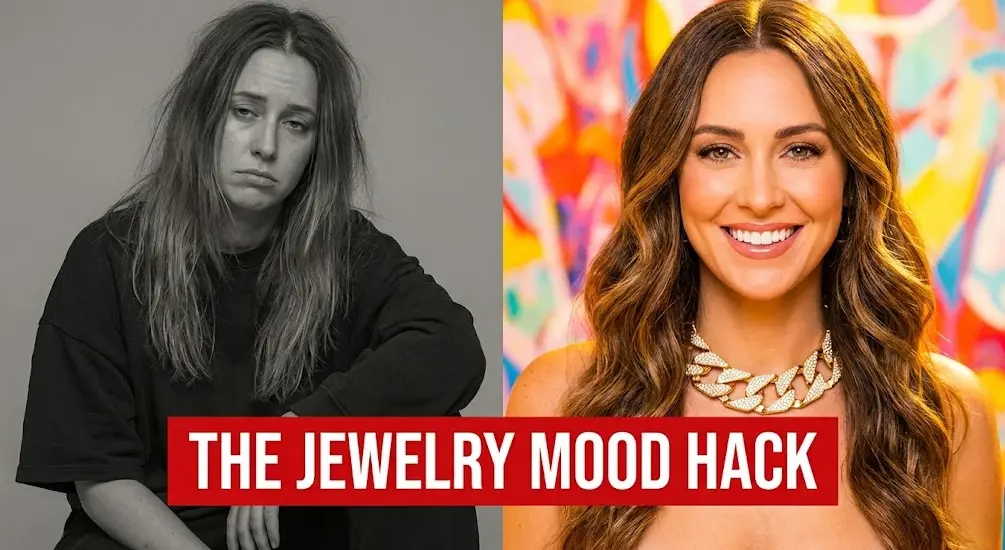
- Enclothed Cognition: New research from Northwestern University shows that wearing certain things, like big, heavy jewelry, changes the way your brain works, how long you can pay attention, and how confident you feel.
- The Dopamine Loop: Just thinking about getting a new accessory releases dopamine before you even wear it. 63.9% of women say they shop to feel better or treat themselves after a long week.
- Metal and Mood Matching: The undertone of your skin doesn’t just affect your style; it also affects how well you get along with others. Yellow gold makes warm undertones (green veins) stronger, and silver makes cool undertones (blue veins) more stable. This creates a “glow” that others subconsciously see as health.
(1) What does jewelry do to your brain chemistry?
Yes, jewelry changes your mental state by a process called "Enclothed Cognition," which connects physical feelings to abstract ideas.
People think they wear jewelry to make their bodies look better, but cognitive science says we wear it to make our minds look better. Researchers Hajo Adam and Adam Galinsky came up with the term "Enclothed Cognition" in 2012 at Northwestern University. It describes how clothes and accessories can affect the wearer's mental processes in a systematic way.
Putting on a heavy gold chain or a pair of sharp, geometric earrings doesn't just add weight; it also adds "symbolic meaning." "Heavy gold" makes your brain think of "wealth," "permanence," and "power." Your brain takes on those traits when you wear it. This isn't magic; it's embodied cognition. The physical experience of the object triggers the mental concepts linked to it.
The "Proprioceptive" Confidence Trick
Jewelry has a unique advantage over clothing: it has a certain weight and ability to conduct heat.
- A cold metal cuff on your wrist or swinging chandelier earrings are examples of tactile reminders that give you constant sensory input (proprioception). You feel them every time you move.
- The Check-In: Your brain does a "status check" every time you feel that weight or coldness on your skin. If the jewelry means "boldness" to you, your brain changes your posture, lowers your voice, and changes the way you speak to fit that definition
Atomic Fact: In the original study on Enclothed Cognition, participants wearing a "doctor's coat" made 50% fewer mistakes on tasks that required a lot of focus than those who were wearing normal clothes. This shows that symbolic accessories can directly improve cognitive performance.
The Loop of Anticipation for Dopamin
People talk a lot about "retail therapy," but the science behind it is very clear. It's not having the jewelry that makes you happy; it's looking for it. During the anticipation phase—browsing, adding to cart, and waiting for the package dopamine is released.
In the real world: I have tried this by making a "Wishlist" of jewelry that I don't plan to buy right away. Making the list itself gives you a small dose of dopamine without costing you any money. But when you finally buy and wear the item, the "Enclothed Cognition" kicks in, turning that short burst of dopamine into long-lasting confidence.
(2) What is the "Statement Piece" rule for taking charge of a room?
A statement piece uses the "Visual Anchor" effect to control where other people look and, as a result, how they see your power.
In evolutionary psychology, attention is money. A statement piece, like a big, colorful, or architectural piece, serves as a focal point. Behavioral psychologists say that controlling where your conversation partner looks makes you seem more dominant in the conversation. You control the flow of conversation if you can keep their eyes on your face (with earrings) or your hands (with rings).
The "Rule of One"
New fashionistas often make the mistake of focusing too much on dopamine sources. You must follow the Rule of One to hack perception well. The brain has a hard time processing more than one focal point at a time.
- The Neck-Up Rule says that if you wear chandelier earrings (like 3-inch drops or heavy geometric shapes), the necklace must not be seen or heard. This only draws attention to the face and jawline.
- The Hand-Talker Rule says that if you talk with your hands, you should wear a cocktail ring on your dominant hand. It makes your points stand out more, which makes you seem more passionate and clear. The flash of the ring serves as a visual punctuation mark.
Infographic: The Neckline Matrix
Stop guessing. Use this architectural rule to pair necklaces with shirts for maximum authority. This is based on the principle of "Negative Space" in design theory.
| Shirt Neckline | Best Necklace Match | Psychological Effect |
| V-Neck | Pendant (V-Shape) | Elongates neck; projects elegance and openness. Matches the angle of the jaw. |
| Crew Neck | Collar / Bib Necklace | Adds structure; projects authority and "armor." Closes off the throat chakra (protection). |
| Strapless | Choker | Highlights vulnerability of the neck; projects high-fashion confidence and daring. |
| Button-Down | Short Statement Chain | Fills the void; implies attention to detail and professionalism. "I am put together." |
| Boat Neck | Long Opera Strand | Breaks up the horizontal line of the shoulder; adds verticality and height. |
Geometric shapes are the "Power Suit" of jewelry.
Different shapes send different messages to the mind:
- Triangles and spikes: aggression, sharpness, and edginess. Good for talking things over.
- Circles and hoops: togetherness, softness, and approachability. Great for social and networking events.
- Squares and rectangles: stability, logic, and order. Great for meetings and presentations that are technical.
(3) How can you match metals to your skin tone scientifically?
By examining your venous color and "Undertone Temperature," you can match metals to reduce visual noise and produce visual harmony rather than contrast.
Think of jewelry as makeup. You appear washed out if you use the incorrect foundation; this also holds true for metal. According to jewelry expert Sally Rong (Founder of Rellery), "Silver, being universally appealing… is particularly favored among younger individuals due to its modern appeal," but the undertone match is what creates true harmony.
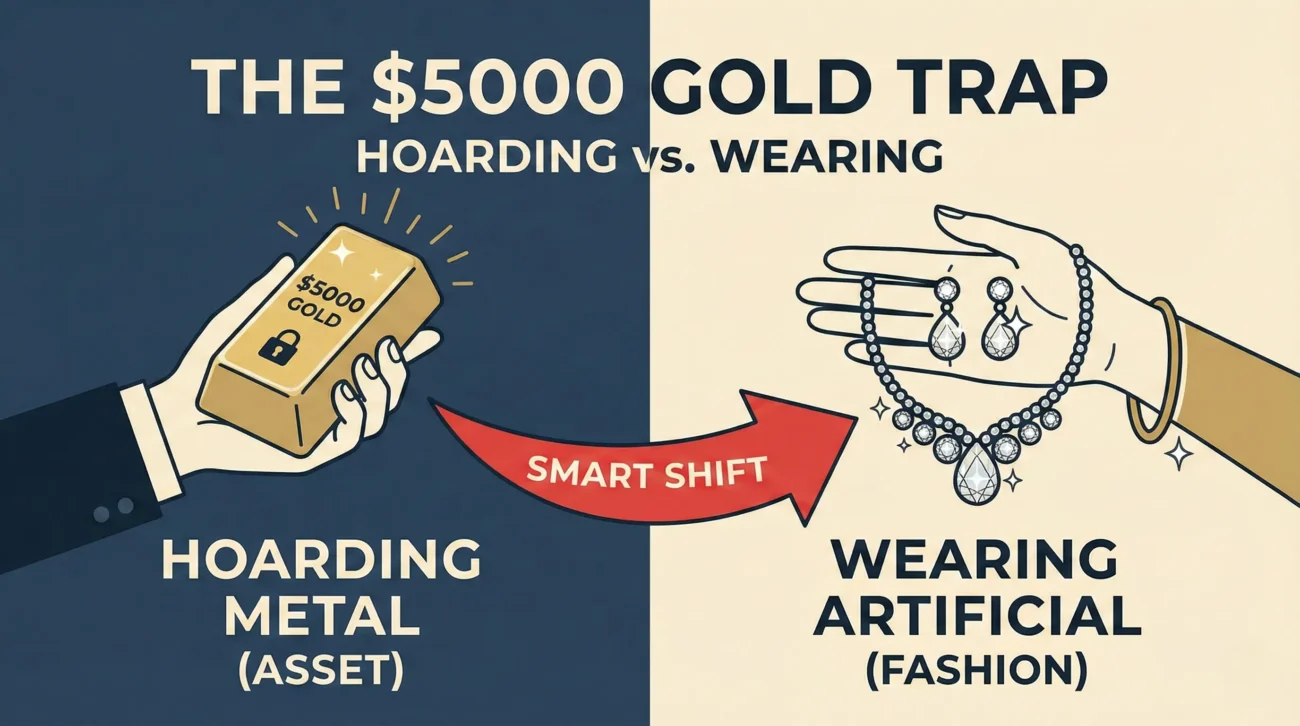
If you can not afford real jewelry then people are shifting towards artificial jewellery; yes right people are shifting towards artificial jewelry; you can read our de-dollarization article here
The 5-Second Analysis, or the Vein Test
Examine the veins on the inside of your wrist when exposed to natural sunlight, not yellow lightbulbs. Dermatologists and stylists use this as their final test.
- Blue/Purple Veins (Cool Undertones): Your dermis contains less melanin. Sterling silver, platinum, or white gold are required. Your skin is brightened by these metals without appearing "grey" or "sickly."
- Warm undertones from green or olive veins indicate that you have more carotene or melanin. You require 14K - 18K rose or yellow gold. Your skin's golden tone is reflected by the yellow, giving the appearance of "glowing."
- Teal/Invisible Veins (Neutral Undertones): You have won the genetic lottery. Metals can be mixed together without clashing, such as in a Cartier Trinity Ring style.
Expert Advice
"I think you should wear what you love regardless, but gold usually looks best on warmer, darker tones and silver on cooler tones." I'm a true yellow-gold girl."- Alison Chemla, Creative Director of Alison Lou
Advanced Color Theory: Eyes & Gemstones
Beyond metal, the color stone can alter how others perceive your eyes.
- Complementary Colors: Wear orange or amber stones (such as citrine or amber) if your eyes are blue. The blue pops because of the contrast.
- Similar Colors: Wear emerald or peridot if your eyes are green. It produces a calming, harmonious appearance.
- Brown Eyes: Brown is neutral. You can wear deep hues like Ruby (red) or Sapphire (blue) to add depth and drama.
(4) What makes "Permanent Jewelry" so popular?
Because it moves accessories from "decoration" to "identity," permanent jewelry is popular because it fosters a sense of connection and permanence in an otherwise chaotic world.
In 2024 - 2025, the practice of welding a bracelet typically a 14k gold chain directly onto the wrist without a clasp has taken off. It is a ritual of commitment, not just convenience. This is referred to as a "Identity Marker" in psychology an external symbol of an internal reality.
The Effect of "Anchor"
Permanent jewelry becomes ingrained in your body schema, unlike a bracelet you remove at night.
- Bonding: It functions as a contemporary blood pact and is frequently carried out in pairs (mothers and daughters, partners). It represents a connection that is difficult to sever (needs cutting).
- Low-Friction Dopamine: You awaken "dressed." For those suffering from decision fatigue, removing the step of putting on jewelry provides a small but significant mental relief. In the morning, there is one fewer choice to make.
The Process & Psychology
- Selection: Determining your style (dainty, bold, sparkly) is the process of selecting the chain.
- The Flash: To fuse the metal, the welder produces a tiny spark. Adrenaline is released during this "danger" but safe moment, intensifying the emotional memory of the incident.
- A smooth loop is the end result. There is no "weak point" if there is no clasp. In terms of psychology, this strengthens sensations of continuity and wholeness.
Atomic Fact: The "experience economy" sector is expected to grow significantly due to personalized and experiential jewelry, such as welding appointments, and the global jewelry market is expected to reach USD 387.36 billion by 2034. Permanent jewelry captures both of these shifts in consumer spending from "things" to "memories".
(5) Where can you get cheap high-dopamine pieces?
You can get "expensive-looking" fake jewelry from brands that use PVD coating instead of regular flashing. This will make the jewelry last longer and look more real.
You don't have to spend $500 to feel good. Dopamine is released by the brain when it thinks about the reward. In fact, 76% of Americans say they are more excited to wait for online deliveries than to buy things in person.
Material Science 101: The "Costume" Buying Guide
Stay away from pieces that look like plastic to fool the eye (and the ego). You need things that act like solid gold. In product descriptions, look for these specific words:
PVD Plated (Physical Vapor Deposition)
- Definition: A process that coats something in a vacuum and bonds gold to the base metal at the molecular level.
- Why it wins: It is ten times stronger than regular gold plating. It doesn't let water, sweat, or perfume in. This means you can shower in it without worrying about it getting tarnished, just like with "luxury" jewelry.
- Life span: It can last 2 to 3 years if you wear it every day.
Gold Vermeil (pronounced "Ver-May")
- A specific legal standard is what this means. It has to be made of sterling silver and have at least 2.5 microns of gold on top of it (usually 14k or 18k).
- Why it wins: The base is silver, not brass or nickel, so it won't cause allergies. It has the "heft" of real jewelry.
- Longevity: Great if you keep it away from harsh chemicals.
Filled with Gold
- A thick layer of gold is attached to a base metal by heat and pressure. At least 5% of the item's total weight must be gold.
- Why it wins: It's the closest thing to real gold. It doesn't peel or flake.
- How long it lasts: 10 to 30 years.
How to Tell the Difference Between Real and Fake Stones
If you want to buy cubic zirconia (CZ) or glass to look like diamonds:
- The Cut: Look for "Emerald Cut" or "Brilliant Cut." When glass is cut badly, it looks flat.
- The Grade: Look for CZ with a 5A grade. To the naked eye, it looks almost exactly like a real diamond when it bends light (fire and brilliance).
- The Setting: Real diamonds have prongs that hold them in place. Cheap fakes are glued in place. Always check for prongs.
My "Dopamine" Test in the Real World
I put this theory to the test by wearing a huge, vintage-style gold lion-head ring (which cost $25) to a meeting with a very important client.
- The Feeling: The ring's weight made me move my hands more carefully. I felt safe and "armored."
- The Reaction: Before we even got to the agenda, three different people said something about the ring. It broke the ice and made people see me as a "creative" person in the room.
- The $25 ring gave me the same boost of confidence as my $2,000 heirloom watch because it stood for strength, not because it cost a lot.
(6) How to use jewelry to change your mood?
By using the brain's ability to make connections between memories, you can create specific jewelry "capsules" that bring about different emotional states.
You should have jewelry for "Focus" and jewelry for "Party," just like you have a playlist for the gym and a playlist for sleep.
The "Deep Work" Capsule
- Goal: Stay focused and don't let anything get in the way.
- Things: stud earrings, a smooth ring (like a spinner ring or a plain band).
- Psychology: Don't wear bracelets that hang down and hit the keyboard. The noise stops flow state. A spinner ring lets you "fidget," which can actually help lower cortisol levels when you're doing something stressful.
The "Social Butterfly" Capsule:
- Its goal is to make you more approachable and get people talking.
- Things like lockets, charm bracelets, and birthstone rings.
- Psychology: These things have stories. You have a story ready when someone asks, "What is that stone?" This lowers social anxiety by giving you a script.
The "Date Night" Pill
- Goal: sensuality and movement.
- Items include drop earrings and lariat necklaces, which are long chains that hang down into the neckline.
- Psychology: These things move when you do. They catch the eye in erogenous areas like the neck, ears, and collarbone. The movement looks like biological signs of life.
Conclusion
The psychology behind jewelry is easy: you don't dress to impress others; you dress to tell your brain who you are today. The "sparkle" is just a trigger, whether it's a $15 pair of oversized hoops that make you feel like a celebrity or a welded bracelet that reminds you of a loved one. It is a real key that opens up the confidence that is already inside you.
When you learn about Enclothed Cognition, the dopamine loop, and the physics of color theory, you stop being a passive consumer of fashion and start being an active architect of your own mood.
Questions That Are Often Asked
A: Yes, but you can't have Nickel. Nickel is the most common allergen in cheap jewelry. The costume jewelry market is worth $31 billion, and a lot of it has nickel in it. It makes contact dermatitis, which is a red, itchy rash. To avoid getting "green skin," look for labels that say things like "Hypoallergenic," "Surgical Steel," or "Brass base with 18k Gold Plating." The copper in brass reacts with your sweat, which makes your skin green. It's not dangerous, but it looks bad. Putting clear nail polish on the inside of the ring can stop this
A: Yes. Black metals like oxidized silver, black rhodium, and black ceramic don't mean "wealth" like other metals do. Instead, they mean "mystery," "rebellion," and "authority." It puts some space between you and the other person, which can be helpful in negotiations or when you want to keep your energy safe.
A: Don't use chemical dips or ultrasonic cleaners on gold-plated or costume jewelry. They will take off the thin layer of gold and ruin the illusion right away.
The Method: Use a small amount of Dawn dish soap and warm water.
The Tool: Use a soft baby toothbrush to scrub gently to get into cracks.
The Finish: Use a microfiber cloth to dry it right away. Don't let it air dry because water spots can ruin the finish.
A: A "Conversation Piece." Put on a one-of-a-kind brooch, an old watch, or a ring with an unusual stone, like Malachite or Lapis Lazuli. It makes people feel comfortable asking you a question, which takes the pressure off of you to start the conversation. It serves as a social link.
A: Yes, both historically and psychologically. Gold is linked to the sun, warmth, royalty, and divinity (which never changes). The moon, intuition, modernity, and technology are all linked to silver. Gold can make you feel more "grounded" and "warm," while silver can make you feel more "sleek," "efficient," and "futuristic."
A: Yes. "Fidget jewelry" or "anxiety rings" are becoming more and more popular. The outer bands of these rings spin. This repetitive motion lets out nervous energy in a way that is both stylish and discreet, like a fidget spinner. It keeps the hands busy, which helps the mind stay grounded.