
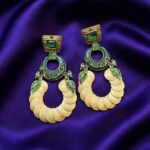
 Earrings
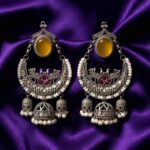 Chandbalis
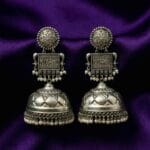 Jhumkas
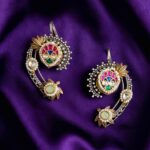 Earcuffs
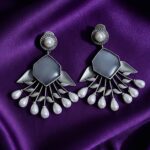 Oxidized Earrings
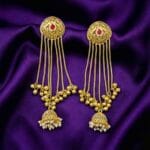 Tassel (Long Earrings)
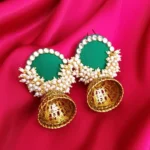 Handmade Fabric Earrings
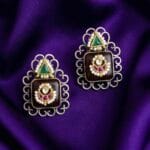 Kundan
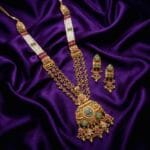 Necklace
 Royal Heritage Necklaces
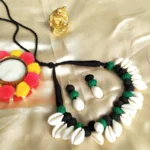 Handmade Necklace
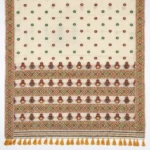 Saree
Saree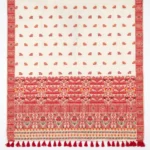 Assamese Saree
 Personalized Gifts & Decor
 3D Miniature Frames
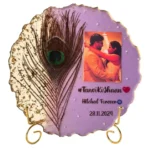 Resin Art Gifts
 Photo Frames
Uttar Pradesh
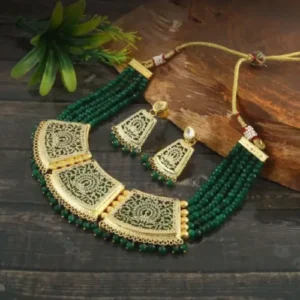
In Uttar Pradesh, a woman on her wedding day wore a traditional gold jewellery style called thewa, a gold pendant-style necklace or bracelet.
Thewa Jewelry – Made Step by Step
- Base Preparation: Broken terracotta pieces are ground into a fine powder, mixed with oil and chemicals, and spread on a wooden board to make a strong base.
- Gold Sheet: A very thin sheet of 23-carat gold is placed on this base.
- Design Drawing: The artisan draws freehand designs on the gold sheet.
- Highlighting: Black paint is applied so the design becomes clear and easy to see.
- Carving: Using fine tools, the craftsman carefully removes extra gold, leaving behind detailed patterns.
- Motifs: Designs often show Hindu gods, Mughal court scenes, stories of bravery, or nature like flowers and animals.
- Glass Work: Specially treated colored glass is used to give a sparkling effect, making the gold stand out beautifully.
- Time Taken: Each piece is fully handmade and can take up to a month to finish.
Source: Pinterest https://in.pinterest.com/pin/16255248650770617/
West Bengal
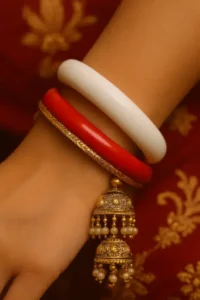
In West Bengal tradition, a married woman wears a white bandle made of a conch shell called shakha and a red coral bangle known as pola. A pair in each hand.
How to make shakha and pola?
- Shakha (white bangle): Made from conch shells. The shell is cut, shaped into a round bangle, and polished until smooth and shiny.
- Pola (red bangle): Traditionally made from red coral. The coral is cut into pieces, shaped into bangles, and polished. Nowadays, because real coral is rare, artisans often use substitutes like red-colored resin or glass.
Tamil Nadu
Newlywed brides in Tamil Nadu wear heavy gold bangles called kempy kalvalai, along with their bridal jewellery, marking the start of their married life.
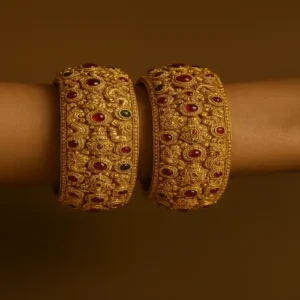
How to make kempy kalvalai?
- Melting the pure gold is melted in a furnace.
- shaping: The molten gold is poured into ma ould or hammered into a rod.
- Forming Bangles: The rod is bent into a round shape to fit the wrist.
- Designing: craftsmen carve patterns, engrave motifs, or add stone.
- Polishing: The bangles are polished until they shine brightly.
Kerala
Traditional jewellery of Kerala includes beautiful gold or gold-plated Lakshmi kadas, maanga maala and kaasu mala. They are all ancient engraved ornaments that passed from generation to generation in the family. The bride wears her wedding dress on her wedding.
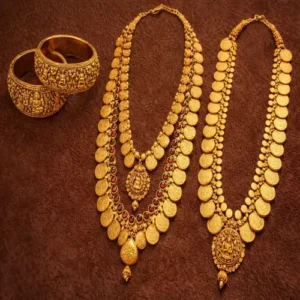
How to make Lakshmi Kada, maang mala?
- Melting the Gold - Pure gold (or gold-plated metal) is melted in a furnace.
- Shaping - The molten gold is poured into moulds or hammered into rods, sheets, or wires.
- Designing -Lakshmi Kada: Thick bangles engraved with Goddess Lakshmi or temple motifs.Maanga Maala: Small mango-shaped pendants are crafted and linked into a chain.Kaasu Mala: Coin-shaped pieces are stamped, engraved (often with Lakshmi), and strung together.
- Engraving - Skilled artisans carve detailed patterns and figures by hand.
- Polishing -The ornaments are polished until they shine brightly.
- Finishing Touches - Stones or enamel may be added for decoration, depending on the design.
Maharashtra
In Maharashtra, the bride wore nath or an iconic nose ring also known as the peshwai Nath on special occasions such as wedding functions, festive occasions, and more. It is crafted from gold and adorned with rubies, pearls or diamonds.
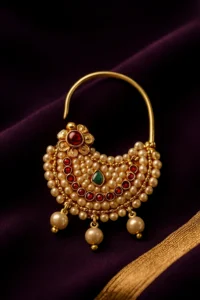
How to make Peshwai Nath?
- Designing the Nath:-
- The process starts with a design sketch.
- The classic Peshwai style includes a curved shape.
- Placement of stones like rubies, pearls, or diamonds is carefully planned.
- Gold Preparation:-
- Pure gold is melted and mixed with alloys (like copper or silver) to make it stronger.
- The gold is then shaped into a thin wire or sheet.
- Shaping the Structure:-
- The gold wire is bent into the signature curved shape of the nath.
- Skilled artisans carefully form the base by hand using small tools.
- Stone Setting
- Tiny holes or settings are created on the gold frame.
- Stones such as:
- Rubies (red stones)
- Pearls (white beads)
- Diamonds (for sparkle)
are placed one by one.
- Traditional techniques like Kundan setting or prong setting are used to fix the stones securely.
- Pearl Stringing
- Small pearls are sometimes threaded along the curve.
- They are either wired or glued carefully to maintain symmetry.
- Polishing and Finishing
- The nath is polished to give it a bright, smooth finish.
- Final cleaning ensures shine and removes any rough edges.
Hook or Clip Attachment
A small hook or screw is added so it can be worn comfortably on the nose.
The pauchi is the traditional jewellery of Uttarakhand. It is made from a unique combination of pearls, beads, and thread that binds them together.
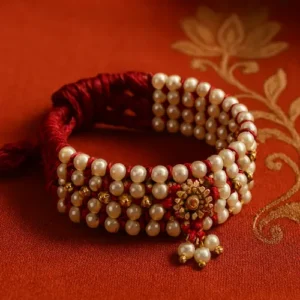
How to make pauchi?
- Material Selection
- Artisans choose:
- Small pearls (usually white or off-white)
- Golden beads or metal balls
- Strong cotton or silk thread (often red or maroon)
- The color of the thread is important, as it adds to the traditional look.
- Thread Preparation
- Multiple strands of thread are taken to make the bracelet strong and slightly thick.
- The threads are aligned and stretched tightly on a frame or held firmly by hand.
- Bead and Pearl Arrangement
- The design is planned before starting.
- Pearls and golden beads are arranged in a repeating pattern.
- Traditionally, Pauchi has multiple rows (usually 4–6 lines) of beads.
- Weaving and Stringing
- Beads and pearls are carefully threaded one by one.
- The artisan weaves them tightly so that:
- The rows stay aligned
- The bracelet looks full and structured
- This step requires patience and precision.
- Creating Multiple Layers
- Several strands are made and then combined together.
- These layers give the Pauchi its thick, rich appearance.
- Adding the Clasp
- A traditional clasp, hook, or adjustable thread tie is attached at the ends.
- Sometimes gold-plated elements are added for extra beauty.
Punjab
Punjabi brides ready for their wedding are expected to wear kalira, which are traditional accessories worn on the wrists of Punjabi brides.
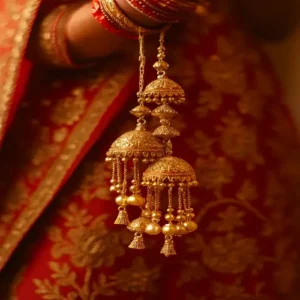
How are Punjabi Kalira made?
- Step 1: Base - A light metal, like brass or copper, is shaped into a small dome or umbrella.
- Step 2: Dangling pieces - Chains, beads, shells, or charms are made and attached to the dome.
- Step 3: Decoration - Designs are added, sometimes with gold plating, pearls, or stones.
- Step 4: Polishing - The whole piece is polished so it shines.
- Step 5: Attachment - The finished kalira is tied to the bride’s bangles (chooda) on her wrists.
Jammu and Kashmir
Dejhoor is a traditional earring worn by brides on their wedding. This bridal jewellery piece has a long pair of gold earrings that hang on a thin gold thread and pass through the ear.
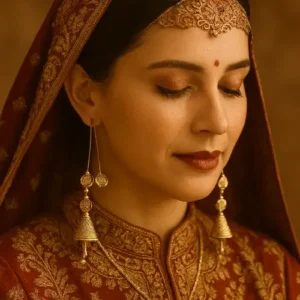
How Dejhoor Earrings Are Made?
- Material Preparation -Traditionally crafted in gold, though sometimes silver or gold-plated versions are made.Gold is melted and shaped into thin sheets or rods
- Hexagonal Design -Artisans cut and shape the gold into this six-sided form.
- Engraving & Detailing - Fine motifs or symbolic lines are engraved on the surface. This gives the ornament its sacred and cultural identity.
- Thread or Chain Attachment -The dejhoor is worn in the ear cartilage piercing.At first, it is worn with a red thread. Later, the in-laws give a gold chain (athoor) to hang it.
- Polishing & Finishing - The ornament is polished to give it a bright shine.Sometimes additional decorative elements are added for elegance.
